How to Buy Land in Sindhudurg: Step-by-Step Guide (2026)


You've found a plot near Kondura or Vengurla that looks right. The survey number checks out, the broker says it's NA, and the price is within your range. Now comes the part most buyers get wrong.
The purchase process in coastal Sindhudurg has five distinct points where buyers are exposed — not from fraud, but from not knowing what "NA" actually means on a 7/12 versus what it means on a brochure, or from not checking CRZ status before paying a token. Buyers lose tokens on plots that can never be built. Buyers register land that still has an agricultural classification on the revenue records. Buyers in the 200m coastal exclusion zone discover after the fact that their sea-view plot is legally unbuildable.
This guide is Sindhudurg-specific — not a generic Maharashtra land-buying primer — because the coastal zone rules, the local revenue offices, and the typical title chain in Vengurla and Kondura have specific characteristics worth naming. If you're still in the 'which area' phase, you'll want to start with the Kondura and Vengurla investment thesis first. If you have a plot in front of you and need to know what to do next, keep reading.
Before You Start: What Type of Land Are You Buying?
This is the most important question in the entire process, and it needs an answer before you do anything else.
In Maharashtra, there are two categories of land that look similar on the ground and are sometimes marketed interchangeably:
Non-Agricultural (NA) plot: Anyone, including NRIs and residents from other states, can purchase this. Construction is permitted (subject to local building rules and CRZ). This is what you want.
Agricultural land: Can only be purchased by a person registered as a Maharashtra farmer. If you are not a registered farmer in Maharashtra, you cannot legally purchase agricultural land. Violating this rule invites penalties under Section 63 of the Maharashtra Land Revenue Code (MLRC), including forfeiture of the land to the state. There is no fine in lieu — forfeiture is the penalty.
YMYL Warning: Non-farmers cannot purchase agricultural land in Maharashtra under Section 63 of the Maharashtra Land Revenue Code; penalties include forfeiture of the land to the state. If a broker or seller tells you this rule has exceptions for NRIs or urban buyers, that is incorrect. Confirm your eligibility with a qualified advocate before paying any money.
How to identify the land type on the 7/12 extract (Satbara Utara):
Column 12 of the 7/12 (the bottom section) shows the land use classification. The key terms to recognise:
| Column 12 Entry | Meaning | Can You Build? |
|---|---|---|
| Bagayat | Irrigated agricultural | No |
| Jirayat | Rain-fed agricultural | No |
| NA (Residential / Commercial) | Non-Agricultural, converted | Yes |
| Gavan Zamin | Village settlement land | Yes (with conditions) |
| Proposed NA | Application filed, not yet granted | No — not yet |
If Column 12 shows any agricultural classification, you are looking at agricultural land. If it shows NA with a specific use type, the conversion has been completed. The distinction matters enormously.
Step 1: Pull the 7/12 Extract (Satbara Utara)
The 7/12 extract is the foundational revenue record for any land parcel in Maharashtra. It is not a title document — it is an administrative record maintained by the Talathi (village revenue officer) — but it is the starting point for every due diligence exercise.
Where to get it: Mahabhulekh — mahabhulekh.maharashtra.gov.in. The service is free. You need:
- District: Sindhudurg
- Taluka: Vengurla (or Malvan/Kudal/Sawantwadi depending on plot location)
- Village name
- Survey number (gat number)
What to check on the 7/12:
Column 7 (Khatadar / ownership): This should show the current seller's name. If multiple names appear, all co-owners must participate in the sale. If the name does not match the person selling to you, that is a red flag requiring immediate investigation — not explanation, investigation.
Column 12 (land use, area, encumbrances): Land classification as described above. Also check the area — it should match the plot dimensions you've been quoted. If the area in Column 12 is significantly larger or smaller than the marketed plot, ask why.
Mutation entries: The 7/12 shows a mutation history — how the land has passed hands over time. A clean chain with documented, registered transfers is a positive signal. Gaps or unusual succession patterns (multiple inheritances without formal mutation) flag a need for a more detailed title search.
Also pull Form 8A (assessment and liabilities) from the same portal. This confirms whether there are any government dues, assessments, or liabilities attached to the parcel. Both documents are free to access online.
Step 2: Verify the Stamped NA Order — Not the 7/12 Entry
This is where a significant portion of Sindhudurg buyers make their critical error.
A 7/12 extract showing "Proposed NA" or "NA application submitted" or even "NA applied" means exactly one thing: someone filed a conversion application with the Collector (under MLRC §44). It does not mean the application was approved. It does not mean construction is permitted. It means paperwork exists.
The document you need to see — physically, not as a description — is the stamped NA Order issued by the Collector (under MLRC §44). This is a separate document from the 7/12. It specifies:
- The survey number(s) covered by the conversion
- The approved use type (residential, commercial, etc.)
- Any conditions attached to the conversion
- The date of order
When you ask the seller for the NA Order and they respond by showing you the 7/12 with a "Proposed NA" entry, the conversion is incomplete. When they say "the NA Order is in process," the land is currently agricultural. When they cannot produce the physical stamped document, treat the land as agricultural until proven otherwise.
YMYL Warning: A "Proposed NA" entry on a 7/12 extract means the application has been filed — it does not mean construction is permitted. Wait for the stamped NA Order from the Collector (under MLRC §44) before treating the plot as buildable. Paying a token or entering an Agreement to Sell on a "Proposed NA" plot before the order is issued means you are negotiating for agricultural land with an uncertain conversion outcome.
If you are buying a plot where the NA conversion is in progress, the Agreement to Sell should explicitly condition the transaction on the NA Order being issued and verified — with a refund mechanism if it is not.
Step 3: CRZ Verification — Coastal Plots Only
Every plot within 500 metres of the coastline (measured from the High Tide Line, or HTL) in Sindhudurg requires CRZ verification before you proceed. This is not optional due diligence — it determines whether your plot can be built on at all.
The Kondura and Vengurla rural coastline is classified as CRZ-III (rural coastal zone). The rules under CRZ-III are:
| Distance from HTL | Regulation |
|---|---|
| 0–200 metres | No Development Zone. No construction permitted ever. Applies even to NA plots. |
| 200–500 metres | Restricted construction. Maximum 33% floor space coverage, maximum 9 metres height (approximately 2 floors), traditional use conditions only. |
| 500 metres and beyond | Standard NA plot rules apply. Normal construction with relevant permissions. |
The practical implication: a sea-view plot 180 metres from the High Tide Line is legally unbuildable, regardless of whether it has NA status, a clean 7/12, or a developer's brochure claiming it is "buildable." The CRZ No Development Zone is absolute.
How to verify CRZ status for your specific plot:
Step 3a — CZMP maps: Go to czmp.ncscm.res.in (Coastal Zone Management Plan maps, maintained by the National Centre for Sustainable Coastal Management). Search for Sindhudurg district, then the relevant taluka (Vengurla) and village. The village-level CZMP map shows CRZ zone classifications overlaid on land parcels.
Step 3b — MCZMA confirmation: Contact the Maharashtra Coastal Zone Management Authority (MCZMA) in writing with your specific survey number and village. Request written confirmation of the CRZ classification for that parcel. This is the only form of CRZ verification that carries official weight.
Step 3c — Licensed surveyor measurement: For plots anywhere near 200–500 metres from the coast, engage a licensed surveyor to physically measure the distance from your plot boundary to the HTL. HTL positions shift, and visual estimates are insufficient for regulatory purposes.
YMYL Warning: Verify your specific plot's HTL distance using CZMP maps at czmp.ncscm.res.in and confirm with MCZMA — broker assurances on CRZ status are not legally binding. A broker who says "this plot is outside the CRZ zone, I checked" cannot indemnify you if the MCZMA determines otherwise. Get written official confirmation.
Step 4: Title Search — The 30-Year Chain
A title search is a formal, advocate-conducted examination of the Sub-Registrar's records for the plot you intend to buy. The standard scope is 30 years — long enough to catch most title defects that could affect your ownership.
The title search confirms:
- The complete chain of ownership transfers, each registered
- Whether any mortgage, lien, or encumbrance is registered against the property
- Whether any acquisition notice, government reservation, or dispute is on record
- Whether the person selling to you has clear, unencumbered title to sell
Engage a Sindhudurg-based advocate who practises in the local Sub-Registrar offices and knows the Vengurla or Malvan registry, not a Mumbai general practitioner who will need to instruct a local correspondent anyway. The local advocate knows the idiosyncrasies of how title chains in this district have historically been documented — including the older Portugese-era land records that still appear in certain villages in southern Sindhudurg.
In parallel, obtain an Encumbrance Certificate directly from the Sub-Registrar's office. This is a government-issued certificate listing all registered transactions and encumbrances against a property for a specified period. It complements the 7/12 mutation history (which shows administrative succession) with registered legal charges.
The title search and Encumbrance Certificate together tell you whether you are getting what you think you are buying. They are not expensive relative to the transaction size. Budget ₹25,000–₹50,000 for a thorough advocate title search in Sindhudurg. Do not skip this step to save money.
For the complete due diligence checklist framework, see property title search checklist for India.
Step 5: Calculate Your Total Cost Before You Negotiate
Most buyers anchor on the per-guntha price or the total land price when negotiating. The actual cost of acquiring the plot is higher — sometimes materially so — and working this out before you negotiate sets the right reference point.
Worked example: ₹50L NA plot in Vengurla taluka
| Cost Component | Amount |
|---|---|
| Purchase price | ₹50,00,000 |
| Stamp duty (5% of market value or agreement price, whichever is higher) | ₹2,50,000 |
| Local Body Tax / LBT (1%) | ₹50,000 |
| Registration charges (~1%) | ₹50,000 |
| Survey and boundary verification | ₹15,000–30,000 |
| Advocate title search | ₹25,000–50,000 |
| Total estimated acquisition cost | ₹53,90,000–54,30,000 |
| Transaction costs as % of purchase price | ~7.8–8.6% |
Stamp duty is levied on the higher of the agreed price or the government ready reckoner (circle rate) value. If the ready reckoner value for the land is ₹60L and you have agreed to pay ₹50L, stamp duty will be calculated on ₹60L. Check the ready reckoner rates for Vengurla taluka at the IGR Maharashtra portal before finalising your offer.
If the land still needs NA conversion:
The NA conversion premium is 50% of the government ready reckoner value for residential use. On a ₹40L ready reckoner plot, that adds ₹20L to the cost before a single rupee of construction begins. This is why NA plots command a significant premium over agricultural land in the same micro-market — the conversion cost and process are already absorbed. When you see agricultural land priced at ₹80,000–2.25L per guntha and NA plots at ₹4–7L per guntha in Kondura/Vengurla, the spread reflects this cost and the legal eligibility difference.
Step 6: Execute — Token, Agreement, Registration, Mutation
Once the 7/12, NA Order, CRZ status, and title search are clear, you move to execution. The sequence matters.
Token / Earnest Money
Typically 5–10% of the agreed price, paid to the seller to take the plot off market while documentation is completed. Pay exclusively via banking channel — cheque, NEFT, or RTGS. Do not pay token money in cash under any circumstances: it compromises your ability to prove the transaction and complicates registration, title documentation, and, for NRIs, repatriation.
Get a written token receipt that specifies: the survey number, village, taluka, the agreed total price, the conditions precedent (NA Order verification, title search completion, CRZ clearance), and the refund terms if conditions are not met.
Agreement to Sell
Drafted by your advocate, signed by both parties, and registered at the Sub-Registrar. The Agreement to Sell should explicitly reference:
- The survey number and area as it appears on the 7/12
- The stamped NA Order number and date
- CRZ clearance status (or the mechanism for obtaining it before registration)
- The title search findings
- Payment schedule and mode
- Any conditions on which the sale is contingent
Registration of the Agreement to Sell creates a legally recognisable record of the transaction in progress.
Sale Deed Registration
Final registration at the Sindhudurg Sub-Registrar office (jurisdiction depends on plot location — Vengurla, Malvan, or Kudal Sub-Registrar as applicable). Both buyer and seller must be present, or their duly authorised POA holders. Stamp duty and registration fees are paid via demand draft or e-payment at the time of registration. The original documents — 7/12, NA Order, prior sale deeds in the chain — are submitted at registration.
The Sub-Registrar issues a registered Sale Deed. Keep the original. This is your ownership document.
Mutation of the 7/12
After registration, file for mutation at the local Talathi office. Mutation is the administrative update that changes the owner's name in the 7/12 to reflect the new owner. It is not automatic after registration — it requires a separate application.
Mutation does not confer title (the registered Sale Deed does), but without it, future 7/12 verification will still show the previous owner's name. This creates unnecessary complications for any future sale, construction permission application, or dispute resolution. Get the mutation done within 30 days of registration.
Step 7: For NRIs — POA, Banking, and TDS
NRIs purchasing NA plots in Sindhudurg follow the same legal process as resident buyers with three additional procedural layers.
Power of Attorney (POA)
An NRI cannot typically be physically present in India through the full documentation and registration process. The standard solution is a notarised POA executed in the country of residence, apostilled (for Hague Convention countries) or consulate-attested (for others), and then registered in India. The POA names a trusted representative in India who can sign the Agreement to Sell, attend registration, and complete the mutation process on the NRI's behalf.
The POA must be specific — it should name the property, the survey number, and the scope of authority. A general POA is legally valid but creates risk if the holder misuses it. See the detailed guidance on NRI Power of Attorney format and safety checks.
Banking Channels
All payments for the property must flow through an NRE (Non-Resident External) or NRO (Non-Resident Ordinary) account held with an Indian bank. Do not send funds through informal channels or have a family member pay from their resident account on your behalf — this creates FEMA complications at the repatriation stage when you eventually sell.
NRE account funds (sourced from foreign income) are fully and freely repatriable after the property sale. NRO account funds (sourced from Indian income — rental income, etc.) are repatriable subject to annual limits and TDS compliance. The choice of account affects your exit flexibility years later. See NRE vs NRO accounts for property transactions for a full breakdown.
TDS
If you are purchasing from an NRI seller, you as the buyer are responsible for deducting TDS at 20% (plus applicable surcharge and cess, or the applicable DTAA rate between India and the seller's country of residence) and depositing it with the Income Tax department before registration. This is not optional and the Sub-Registrar will require evidence of TDS deposit (Form 26QB and the TDS certificate) at the time of registration.
If you are purchasing from a resident Indian seller, standard TDS rules apply based on transaction amount. Consult a qualified CA before executing. See NRI capital gains tax and TDS on property sale for the current rate and DTAA applicability framework.
YMYL Warning: This is informational content based on law as of 2026. NRI real estate transactions have FEMA, income tax, and RBI implications that vary by individual circumstances. Consult a qualified CA and advocate before transacting.
For the complete NRI purchase framework, see what NRIs can and cannot buy in India.
Getting There in 2026: Chipi, Mopa, and What "Near the Airport" Actually Means
Sindhudurg has two airports within reach. Chipi (Sindhudurg Airport, SDW) sits at Parule-Chipi in Vengurla taluka, off the Vengurla–Malvan road. Mopa (Manohar International, GOX) is just across the Goa border on NH66. Which one matters depends entirely on which pocket you are buying in — and a "10 minutes from the airport" brochure line means very different things at each.
Chipi status, as of August 2026. Fly91 is the only airline serving Chipi, with ATR flights to Pune, Hyderabad and Bengaluru (Wikipedia). A Navi Mumbai–Chipi route was announced by Minister Nitesh Rane on 20 July 2026 with a 15 August 2026 start (TravelBiz Monitor); as of 17 August 2026 it had not started and no revised date had been published (IMAD Travel). The airport's track record is uneven: Alliance Air's Mumbai route ran from the 9 October 2021 inauguration and was later suspended, and operations halted again on technical grounds in 2025 until the Maharashtra cabinet approved a restart on 19 August 2025 (ThePrint). Chipi schedules change roughly every quarter. Do not underwrite a purchase on them; underwrite on the road.
Drive times (typical off-peak road times; monsoon adds 20–40%):
| From | to Mopa (GOX) | to Chipi (SDW) | Which airport wins |
|---|---|---|---|
| Shiroda / Velagar | 40–60 min | 45–55 min | Mopa |
| Vengurla town | 60–75 min | 35–45 min | Mopa for flights; Chipi only if your route exists |
| Kondura / Nivati / Bhogwe | 75–90 min | 25–35 min | Chipi on paper; Mopa in practice |
| Malvan / Tarkarli / Devbag | 105–135 min | 30–40 min | Chipi, or the road |
| Kudal | 60–75 min | 40–50 min | Either; Mopa for reliability |
| Sawantwadi / Banda | 30–45 min | 60–75 min | Mopa |
What this means for a buyer. The belt south of Vengurla — Shiroda through Redi — is functionally a Mopa suburb: a Goa flight plus a 40-minute drive, with Mopa's full domestic network behind it. That is the access story underpinning the Shiroda–Velagar Taj hotel land, and the Mopa aerocity thesis explains why the airport's pull reaches across the state line. Malvan, Tarkarli and Devbag are 90+ minutes from Mopa; they depend on Chipi actually flying or on the road from Mumbai and Pune, which is why the Revas–Redi coastal highway matters more to that pocket than any airline announcement. The Shaktipeeth Expressway (Nagpur to Banda, targeted for 2028–29) is a different story again: it ends inland at Banda, not at the coast — see the Shaktipeeth reality check before paying a premium for it.
Common Mistakes Buyers Make in Sindhudurg
These are the patterns that recur across buyers who have gone through this process badly:
-
Paying a token before pulling the 7/12 or seeing the stamped NA Order. The 7/12 is free and takes ten minutes. The stamped NA Order should be available immediately from any legitimate seller. There is no reason to pay before checking both.
-
Accepting "Proposed NA" as sufficient for construction. It is not. An application filed is not an order granted. If the seller cannot show you the stamped NA Order, treat the land as agricultural.
-
Not checking CRZ on sea-view plots before paying. A plot within 200 metres of the High Tide Line cannot be built on under any circumstances. A plot in the 200–500m zone has significant construction restrictions. Verify before you pay anything.
-
Using a Mumbai general advocate for the title search. Sindhudurg's registry records and historical title chains have local characteristics. An advocate who knows the Vengurla or Malvan Sub-Registrar's office will conduct a more reliable search than a Mumbai practitioner instructing a local correspondent they have not met.
-
Paying in cash. Cash payments cannot be documented cleanly, compromise your registration position, and create FEMA complications for NRIs at the repatriation stage. All payments at every stage — token, partial payments, balance — should be by banking channel.
-
Not getting the mutation done after registration. The Sale Deed gives you legal title. Mutation puts your name on the administrative record. Without mutation, every future transaction involving this land starts with a question about why the 7/12 still shows the previous owner.
-
Verifying the developer's RERA number on the brochure but not cross-checking at maharera.mahaonline.gov.in. Some projects in the region have been marketed with RERA numbers that are "in process" or belong to a different phase or a different location. Cross-check at source — the MahaRERA portal — not on the developer's own materials.
Bottom Line
The process of buying land in Sindhudurg is knowable and manageable. It is not particularly complex compared to other states. The traps are almost always in skipping steps rather than in legal complexity — specifically, the NA Order verification, the CRZ check, and the title search.
Budget 2–3 months from plot identification to completed registration and mutation in Sindhudurg. The process timeline is driven by document collection from the seller, the advocate's availability for the title search, and Sub-Registrar appointment scheduling — not by regulatory complexity. Starting with the correct documents in hand compresses the timeline significantly.
For the complete due diligence document checklist that covers this process and more, see property title search checklist for India.
Next step: If you're still in the 'which area' phase rather than 'which plot', start with Kondura Beach land prices and project options or the Sindhudurg vs North Goa real estate comparison first.
Read Next
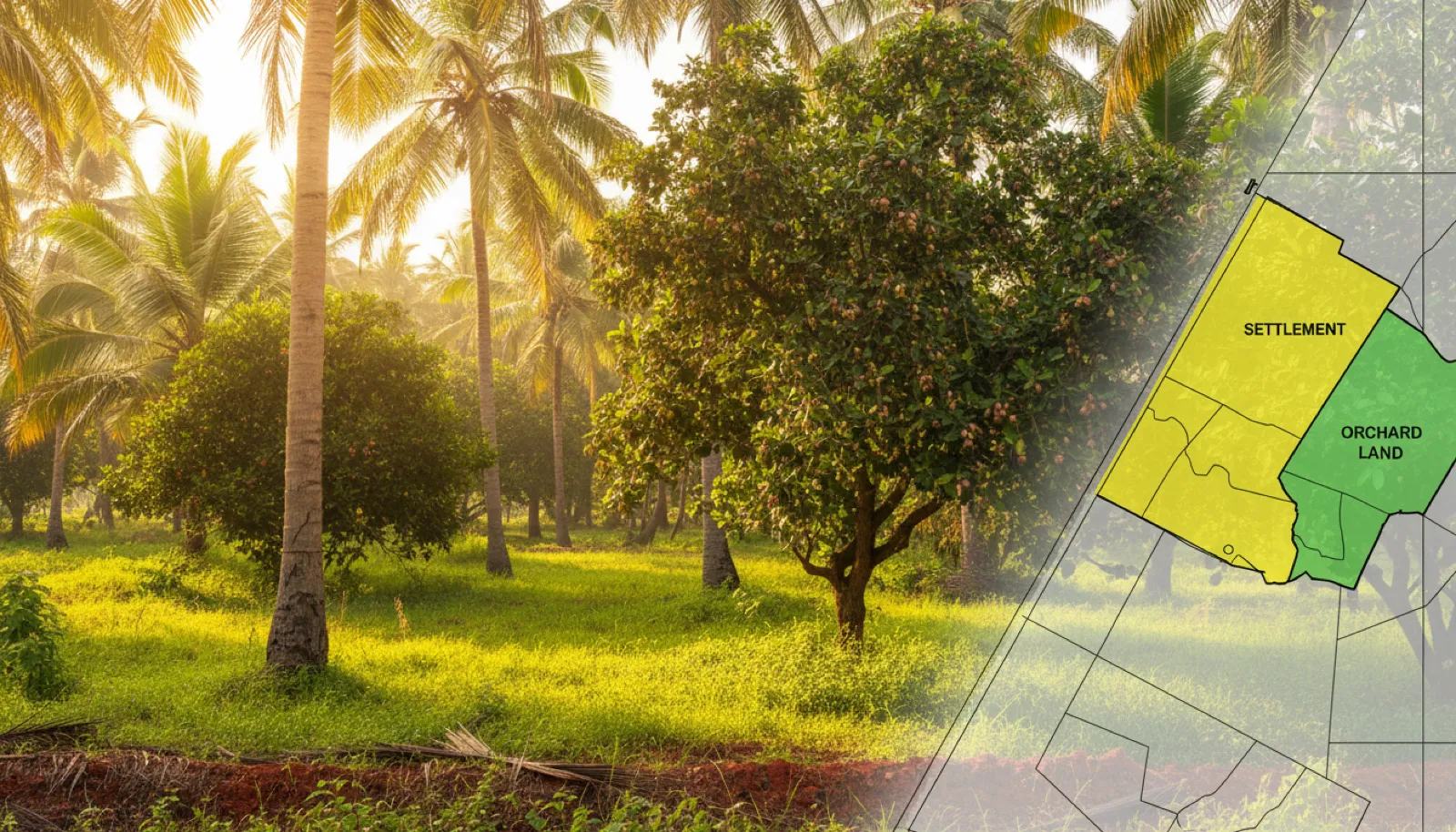
Orchard Land Meaning in Goa: What You Can Actually Do (2026)
What "orchard land" (often misheard as "orchid land") actually means in Goa — the RP21 green zone, what you can and cannot build, why the plots are cheap, and the conversion reality.

Sanad Conversion Cost in Goa: Fees, Slabs & Timeline (2026)
What a conversion Sanad actually costs in Goa — the notified per-sqm fee slabs, the 2024 fee revision, the document checklist, a worked example, and the honest timeline.

Kondura Beach Land: The Definitive Buyer's Guide (2026)
Plots near Kondura beach, Sindhudurg: real prices, CRZ-III rules, Innovest Baywatch review, NA vs agricultural land, and due diligence checklist for NRIs.